
SpaceX Starship's Orbital Refueling Tests Pave Way for Mars Settlement by 2030s

By Oliver Hawthorne on February 6, 2026
SpaceX Starship's Orbital Refueling Tests and Mars Ambitions
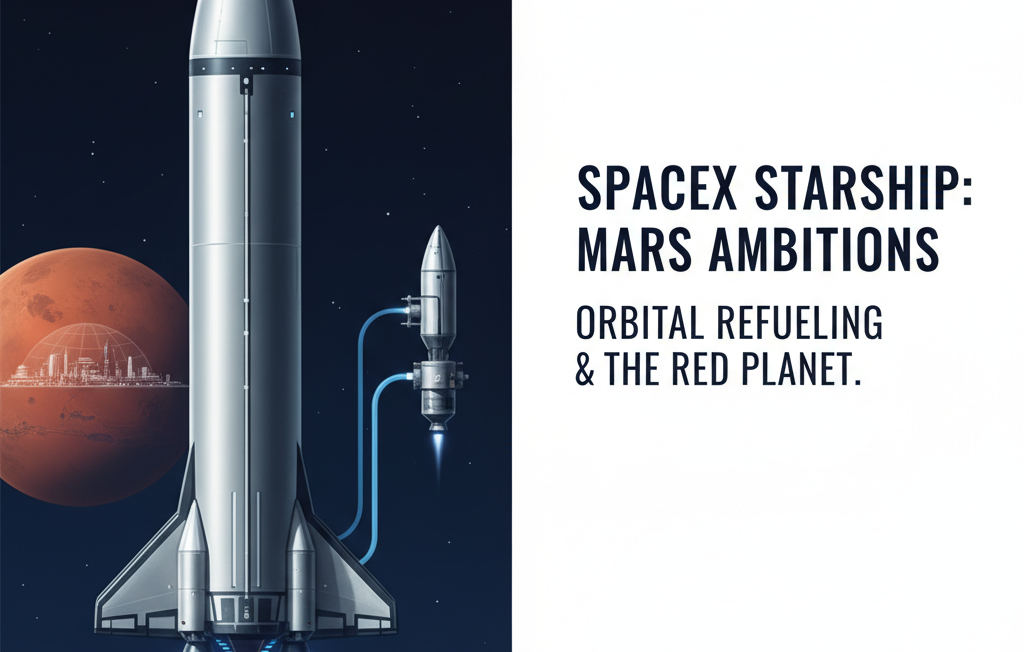
Elon Musk's vision for Mars is not just a distant dream; it's a mission in the making, with SpaceX's Starship at its core. The recent orbital refueling tests mark a pivotal moment for the spacecraft, which is designed to transport humans and cargo to the Red Planet. These tests are crucial for achieving Musk's ambitious timeline of establishing a human settlement on Mars by the 2030s.
Key Takeaways
- The latest Starship test in August successfully survived re-entry and splashed down intact, a significant milestone in spacecraft development.
- Starship's orbital refueling capability is essential for long-duration space missions, allowing it to carry more payload beyond Earth's orbit.
- SpaceX plans to launch five uncrewed Starships in 2026, timed with the ideal alignment of Earth and Mars.
- The success of orbital refueling tests will directly affect the feasibility of missions to Mars and beyond.
- SpaceX's long-term goal involves creating a self-sustaining city on Mars, supporting human life and exploration.
- Musk's timeline for Mars colonization aims for the first human landings in the 2030s, contingent on successful Starship flights.
- The technology developed for Starship will benefit various sectors, including satellite deployment and interplanetary travel.
The Significance of Orbital Refueling
Orbital refueling is a game changer for space travel. It allows a spacecraft to take on additional fuel while in orbit, significantly extending its range and payload capacity. Starship's design incorporates this capability, which is vital for missions that stretch beyond the Moon. During the August test, SpaceX demonstrated that Starship can withstand the harsh conditions of re-entry, marking a leap forward in proving the spacecraft's readiness for future missions.
This capability enables longer missions, which are essential for a Mars journey. By refueling in orbit, Starship can carry more supplies and equipment, enhancing its potential for human exploration and settlement on Mars.
The Path to Mars
SpaceX aims to launch five uncrewed Starship missions in 2026, aligning with the optimal window for Earth-Mars travel. This timing is critical; every 26 months, the orbits of Earth and Mars align, making it easier and more efficient to send spacecraft to the Red Planet. If successful, these missions could set the stage for the first human landings on Mars in the 2030s.
Musk's vision for Mars includes not just landing astronauts but establishing a self-sustaining city with a population capable of living and working on Mars. This ambitious plan includes building infrastructure for agriculture, energy production, and habitation, which would support long-term human presence.
Challenges Ahead
While the prospects are exciting, the challenges are significant. SpaceX must navigate technical hurdles, including perfecting the orbital refueling process and ensuring Starship's reusability. Each test provides valuable data that informs future designs and operational strategies. The successful August test was a positive step, but it is just one of many needed to ensure safety and reliability for future missions.
Additionally, SpaceX needs to address regulatory and logistical challenges. Coordinating with international space agencies and securing the necessary approvals for Mars missions will be crucial.
The Bigger Picture
The technology SpaceX develops through Starship is likely to have far-reaching implications beyond Mars missions. The ability to launch large payloads into orbit and refuel spacecraft could revolutionize satellite deployment and even pave the way for interplanetary travel. As SpaceX pushes the boundaries of what's possible in space exploration, it also inspires a new generation of scientists and engineers.
SpaceX's journey to Mars is a bold undertaking that reflects humanity's innate curiosity and desire to explore. With each test flight and technological advancement, the dream of making life multiplanetary inches closer to reality.
Conclusion
SpaceX's Starship is more than just a spacecraft; it represents a bold leap into the future of space exploration. As the company continues to conduct orbital refueling tests and refine its technology, the vision of a human settlement on Mars becomes increasingly tangible. The countdown to the first crewed mission is on, and the world watches with bated breath. In this race to Mars, the stakes are high, the challenges are daunting, but the potential rewards are limitless. The journey of a thousand miles begins with a single step, and for SpaceX, it's just the beginning.